 11
11
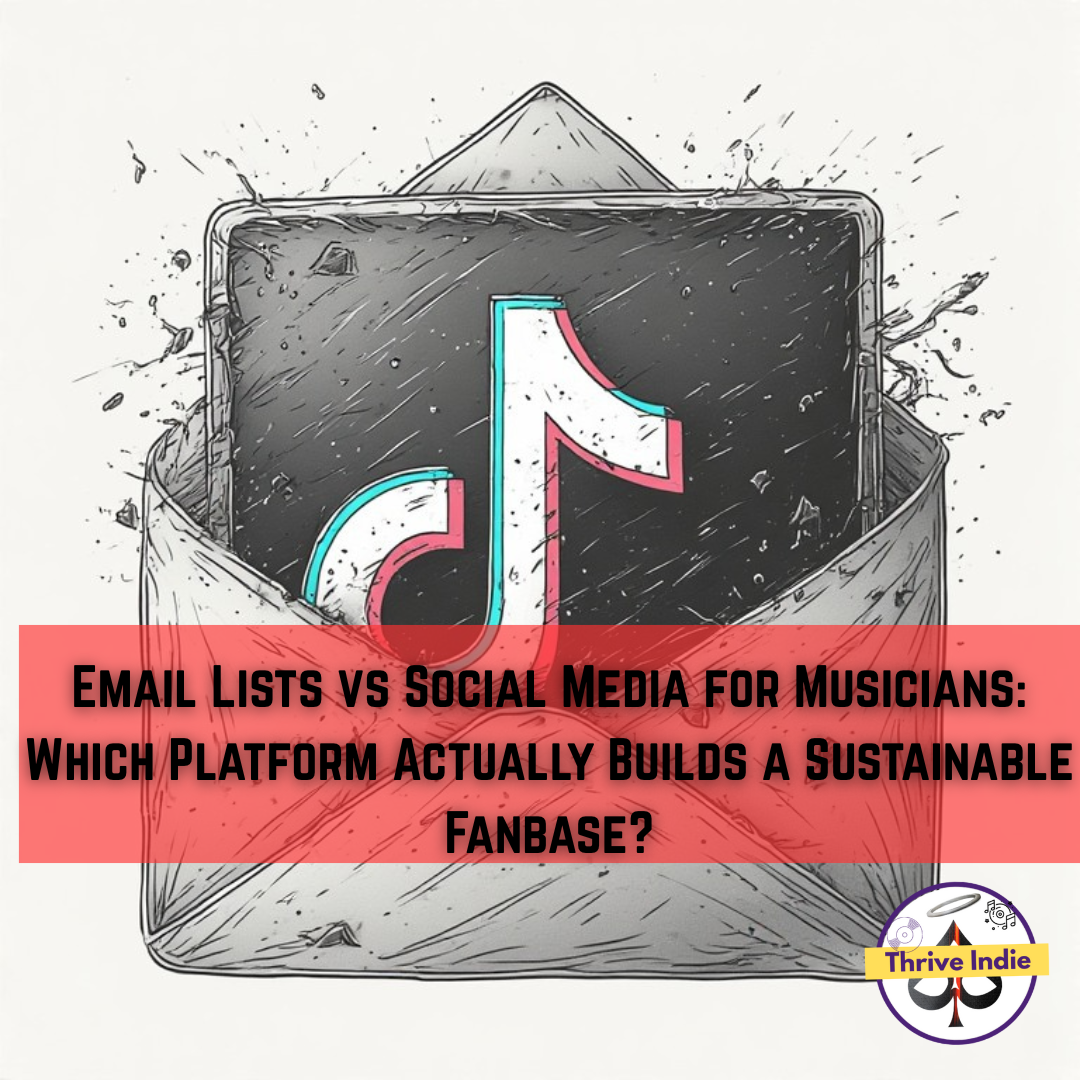

Independent artists are building careers on rented land. Social media is not a home for independent artists. They don’t control the algorithm, and they don’t own the fans. Artists who last built their platforms and moved audiences from the rented space to controlled space.
Instagram followers, TikTok views, and YouTube subscribers are all vanity statistics. An email list breaks down into what’s called a revenue statistic.
The real question isn’t which platform grows faster — it’s which platform builds durable leverage.
For independent musicians serious about long-term growth, understanding the difference between email lists and social media is critical.
For a broader framework on building a lasting audience, check out our pillar guide: How Independent Artists Get Fans Without A Label
Social media is powerful — but volatile.
Organic reach on Facebook has declined dramatically over the years. Studies from Hootsuite consistently show declining organic reach across major platforms, especially for business accounts. This is just one example of how things can shift when relying on rented platforms. Algorithms shift consistently as they move to keep up with their audience. They don’t care how beneficial the algorithm is to their users’ career goals, as long as the content being published creates engagement. That is why TikTok can explode overnight — and disappear just as fast.
Algorithms reward engagement spikes, not sustained relationships.
Here’s what that means for musicians:
A follower count is not ownership.
If your account gets restricted or the platform changes policy, your access to your audience can vanish instantly.
That’s risk.
Email remains one of the highest-converting marketing channels, delivering an average ROI of $36-$42 for every $1 spent! While on social media, the average return per $1 spent is around $3-$5.
More importantly for musicians:
When an artist sends an email, they are not competing with an algorithm feed.
They are landing directly in a fan’s inbox.
That is a direct relationship.
Artists like Chance the Rapper leveraged direct fan communication early in his career to mobilize listeners for releases and tours without traditional label backing. The principle remains the same today: direct access equals leverage.
Social media still matters.
It is the top-of-funnel engine.
Platforms like TikTok and Instagram drive discovery. Spotify’s own data shows that viral moments can drive short-term streaming surges — but repeat listening determines long-term algorithmic support.
Social platforms are built for:
But they are not built for permanence or longevity.
Think of social media as the highway.
Email is the home address.
The debate isn’t either/or.
It’s sequencing.
Independent artists who skip Step 2 stay dependent on algorithms forever.
Artists like Russ built early momentum by creating direct access channels with fans and emphasizing ownership and independence. His strategy demonstrates the value of controlling distribution and communication.
Here’s what most artists overlook:
Streaming platforms reward repeat behavior. Email lists reward new content.
When you email fans about a new release:
Those signals trigger algorithmic amplification.
So, email does not replace streaming platforms. It strengthens them.
Without a mobilized base, your release depends entirely on passive discovery.
That’s unstable growth. An independent artist can not generate a dependable income from such volatility.
Consider touring.
If you have 50,000 Instagram followers spread across multiple countries, that does not automatically translate into ticket sales in a specific city. Nor does it automatically translate to sales at all.
In 2019, an Instagram influencer @Arii failed to sell 36 t-shirts even while flexing a 2.6 million follower count. And her case isnt a rare one.
That’s because followers do not equal fans.
But if you have:
You can mobilize efficiently.
That’s monetizable audience data.
Many music insiders have long emphasized the importance of artist-controlled infrastructure and direct-to-fan systems in independent sustainability.
Email builds infrastructure.
Social builds attention.
Artists who rely exclusively on social media often experience:
Social media metrics look impressive.
Email metrics generate revenue.
That’s the difference.
Here is the optimal structure:
Top Funnel:
TikTok, Instagram Reels, YouTube Shorts
Middle Funnel:
Lead magnets (exclusive songs, early access, behind-the-scenes content)
Bottom Funnel:
Email list → Merch drops → Tour announcements → Direct fan offers
The artists who treat email as infrastructure outperform those chasing platform momentum.
Social media builds visibility.
Email builds leverage.
Independent artists who ignore email are building audiences they do not control.
If you want career stability, predictable revenue, and long-term fan retention — email wins.
2 thoughts on “Email Lists vs Social Media for Musicians: Which Platform Actually Builds a Sustainable Fanbase?”