 11
11
For years, we’ve been told the music industry is “evolving.”
That’s only partially true.
What’s actually happening is far more structural—and far more important:
The music industry is consolidating into a tightly connected system controlled by a small group of powerful players.
This isn’t speculation. It’s visible in real-time through acquisitions, mergers, and investment patterns across labels, distributors, AI startups, and live event companies.
A large part of this understanding comes from the work of Cherie Hu and her team at Water & Music, whose Music Tech Ownership Ouroboros maps how ownership, capital, and influence circulate throughout the industry. Their analysis reveals something critical:
→ The biggest companies aren’t just competing
→ They’re investing in each other
→ And increasingly controlling the entire value chain
You can explore their full breakdown here:
This creates a new reality for independent artists:
You’re not just participating in the music industry—you’re operating inside a system.
Traditionally, the music industry was framed as competitive:
But today, that model is breaking down.
Major players are:
This leads to a structural shift:
Power is no longer about market share—it’s about ecosystem control.
This concept is explored further in our upcoming deep dive:
👉 The Music Industry Isn’t Competitive Anymore—It’s Controlled

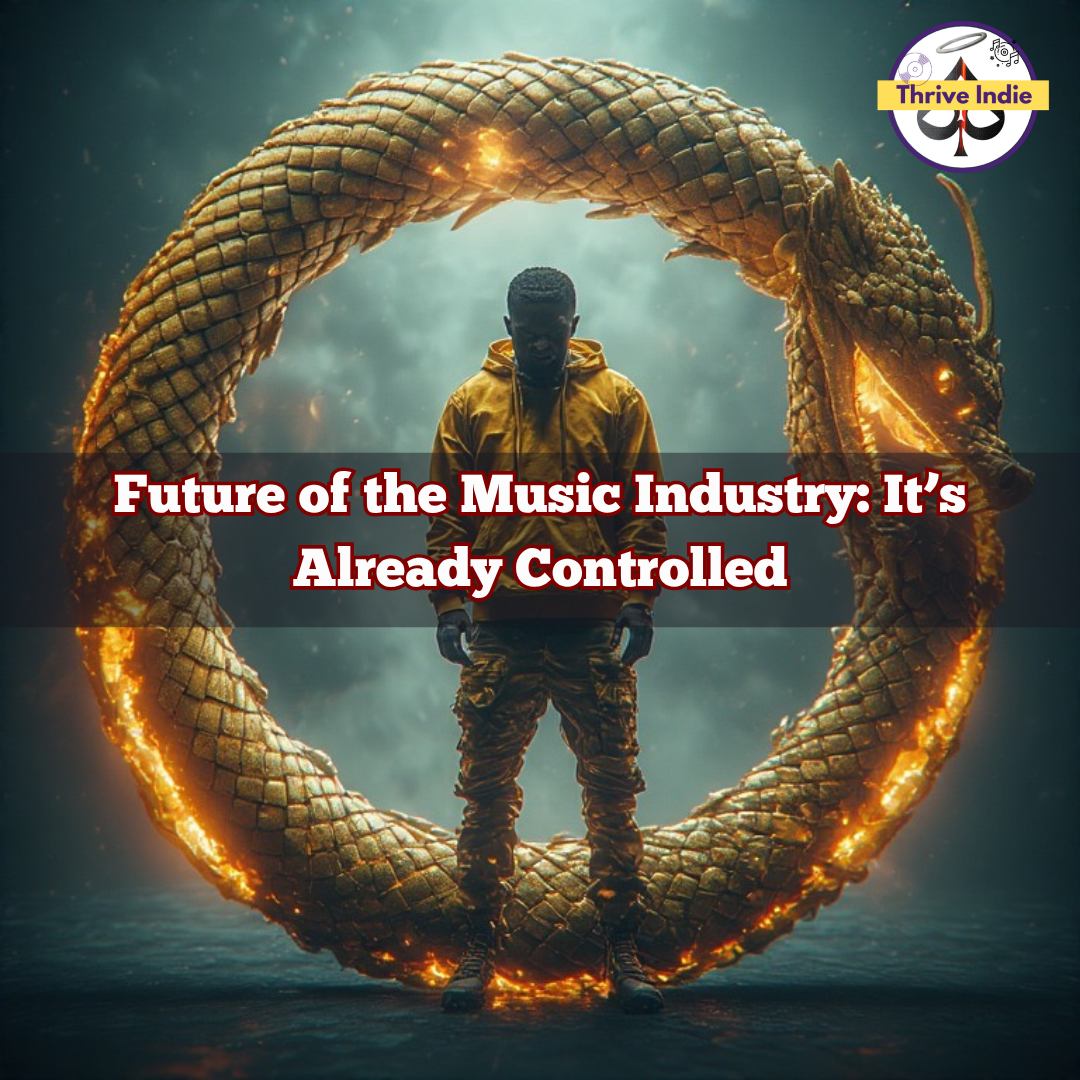
One of the most important ideas from Water & Music’s research is the ownership loop, or “Ouroboros”. The Ouroboros is an ancient symbol of a serpent or dragon devouring its own tail, representing eternity, cyclic renewal, and the unity of opposites. In this case, the opposites (head and tail) are the disruptive indie tools/platforms and the conventional major labels.
At the highest level of the industry:
This creates a system where:
Ownership, influence, and revenue all circulate within the same network.
For independent artists, this has a direct implication:
You may think you’re choosing between platforms…
But often, you’re still inside the same system.
As capital consolidates, three key battlegrounds are emerging.
AI is no longer experimental—it’s infrastructure.
From production tools to voice models and workflow automation, AI is rapidly becoming embedded across the creative process.
But here’s the key insight:
Investors aren’t just funding AI tools—they’re building entire AI ecosystems.
This includes:
We break this down further here:
👉Why AI and Live Music Will Dominate the Next Decade
At the same time AI is scaling music digitally, live experiences are becoming more valuable—not less.
Why?
Because:
As music becomes abundant, real-world experiences become scarce.
This is why:
The future isn’t AI vs live.
It’s AI driving demand for live.
This is the most overlooked—and most important—layer.
Behind every stream, sync, or payout is one core issue:
Who owns what—and how that data is managed.
Metadata, rights ownership, and licensing infrastructure determine:
Increasingly, companies aren’t just buying catalogs.
They’re building systems to:
We explore this shift in depth here:
👉 [The New Power Shift: Why Music Ownership Is Moving to Data]
Another major shift:
Investors are no longer betting on standalone startups.
They’re assembling portfolios that control entire workflows.
This includes:
The strategy is clear:
Own every layer → Control the outcome
This trend is explored further here:
👉 [How Investors Are Quietly Reshaping the Music Industry]
If you’re an artist, this shift changes how you should think about your career.
The old model:
The new reality:
You are operating inside platforms that are part of larger financial systems.
Which raises a critical question:
Are you building independence—or dependency?
One of the biggest risks in this new system is confusing access with ownership.
Streaming platforms, social media, and marketplaces give you reach.
But they don’t give you control.
This is why the most successful independent artists are shifting toward:
We’ve covered this extensively in:
How Independent Artists Make Money in 2026
How Many Fans Do You Actually Need to Go Full-Time as an Independent Artist
What to Offer in a $5 Membership Tier
Publishing Administration vs DIY
Each of these strategies moves you closer to ownership—and further from dependence.
When you zoom out, the industry becomes clearer:
So the question isn’t just how to grow as an artist.
It’s:
Where do you sit inside the system?
This is the focus of another upcoming breakdown:
👉 [Are You Building a Career—or Feeding the Algorithm?]
The music industry isn’t collapsing.
It’s becoming more organized, more financialized, and more interconnected.
And that creates both:
Because while the system is powerful…
It doesn’t have to own you.
The artists who win in this next era will be the ones who:
Because in a world where everything is being absorbed into larger ecosystems—
True independence becomes the ultimate advantage.