 11
11
How Should We Measure Cultural Impact?
The biggest mistake in today’s music debates is assuming cultural impact can be reduced to a single number.
One week it’s first-week sales. The next it’s streaming records. Then it’s social media engagement, awards, or chart longevity. When those numbers don’t support someone’s favorite artist, the conversation shifts to “culture.”
Media personalities like Ebro have become some of the loudest voices in this conversation, arguing that the industry has become too obsessed with commercial success. His broader question is an important one:
When we measure greatness, what are we actually measuring?
It’s a question worth asking.
Where I disagree is the idea that culture and commerce exist on opposite sides of the spectrum. They don’t.
Commercial success often helps tell the story of cultural impact. Likewise, cultural relevance frequently creates commercial opportunities. The two constantly reinforce one another. Commerce can amplify culture, while culture can generate commerce. They’re not opposing forces—they’re symbiotic.
The real problem isn’t that we pay attention to sales. It’s that we often mistake a single metric for the entire picture.
When people argue about cultural impact, they usually point to whatever statistic supports their position. Sales, streams, chart performance, awards, and social media engagement. But none of these, on their own, fully explain why certain artists reshape an era while others simply have a successful release.
A single statistic doesn’t measure culture because it isn’t a single thing. Researchers in sociology, media studies, and music education have long treated cultural impact as something multidimensional. It’s the collection of ideas, behaviors, conversations, symbols, and memories that shape how people think and act. That means measuring cultural impact requires a multidimensional approach rather than a single scoreboard.
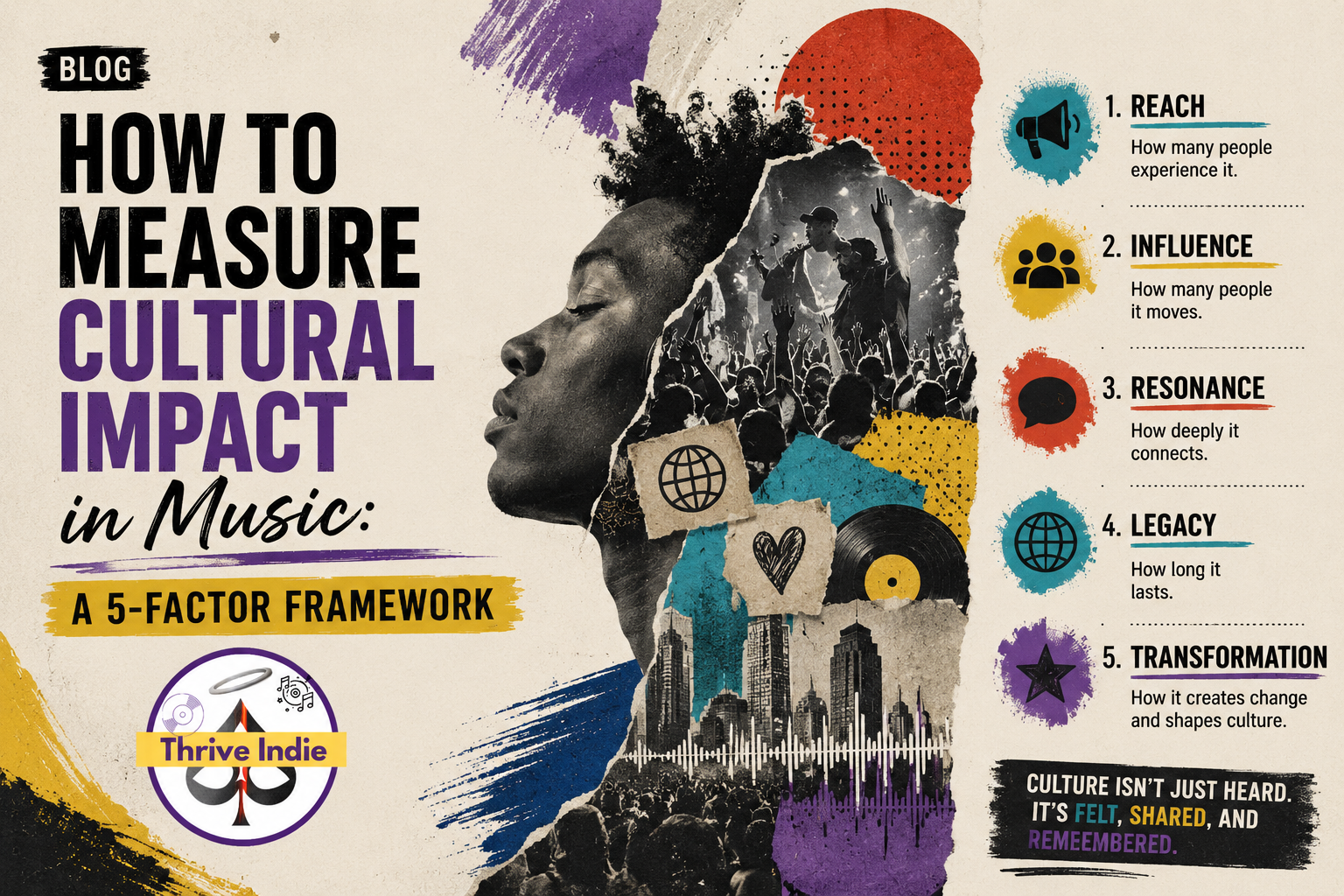
After studying both the research and decades of music history, I’ve found that cultural impact can be better understood through five interacting dimensions:
Cultural Impact = Attention × Conversation × Influence × Behavior Change × Longevity
Notice this isn’t addition—it’s multiplication.
That’s intentional. In systems theory and economics, multiplicative models are often used when multiple variables depend on one another rather than contribute independently. Cultural impact behaves similarly: a zero or near-zero score in one dimension substantially limits the effect of the others, while strength across all dimensions produces compounding influence
An artist, like Lil Nas X, can dominate headlines but inspire little lasting change. Another might influence an entire generation of musicians without ever reaching massive commercial heights- think Chief Keef, Gang of Four, and Velvet Underground. Others may generate endless online conversation that disappears a month later.
True cultural impact happens when multiple forces reinforce each other.
The artists who genuinely shape culture don’t simply win on one dimension.
They leave fingerprints across all five. That’s how they can change the trajectory of culture itself.
This framework also explains why so many debates about music never reach a satisfying conclusion. Two people can look at the same artist and arrive at completely different opinions because they’re measuring different dimensions.
One person values commercial reach. Another values influence. A third prioritizes longevity. None of them are necessarily wrong—they’re simply using different metrics. Without agreeing on what constitutes cultural impact, discussions about “greatness” quickly become arguments over isolated statistics instead of the broader picture.
Looking at cultural impact through multiple dimensions also reveals something important: every artist has a different impact profile. Some become catalysts for entirely new movements. Others refine an existing sound and bring it to the mainstream. Some reshape fashion, language, or technology without producing the biggest commercial numbers. Others dominate the charts but leave relatively few lasting changes behind.
Understanding these differences allows us to move beyond simplistic rankings and begin asking better questions about how artists actually influence culture.
Ultimately, cultural impact isn’t about proving that one artist is objectively greater than another. It’s about understanding the different ways music leaves its mark on society.
The framework I’ve proposed isn’t intended to end the debate—it’s intended to make the debate more thoughtful. In the sections that follow, we’ll examine each of the five dimensions individually, exploring why Attention, Conversation, Influence, Behavior Change, and Longevity each contribute to an artist’s place in cultural history. Only by looking at all five together can we begin to answer one of music’s most enduring questions: Who truly changed the culture, and how did they do it?
An idea cannot influence people if no one knows it exists. That’s why every cultural movement begins with attention.
Attention is the mechanism that introduces music into public consciousness. It explains why marketing, media coverage, playlist placement, touring, viral moments, and even controversy matter. They increase exposure.
However, attention by itself has no lasting value.
Thousands of songs trend every year. Most disappear just as quickly as they arrived. Going viral creates awareness, but awareness alone doesn’t create legacy.
Attention is simply the invitation. What happens next determines whether culture changes.
Culture doesn’t happen in isolation; it happens when people talk.
Artists with cultural impact become part of everyday conversation. Their music is debated, and interviews are dissected. You will see their lyrics become captions and their fashion choices turn into trends. Their names appear in podcasts, classrooms, documentaries, memes, and everyday discussions.
Conversation extends the life of an idea.
Sometimes the music isn’t even the center of the discussion anymore. Instead, the artist becomes a reference point for larger conversations about identity, race, politics, technology, business, or creativity.
The more an artist becomes embedded in public dialogue, the deeper their cultural roots become.
One of the clearest indicators of cultural impact is imitation.
When enough artists begin borrowing your sound, your aesthetic, your marketing strategy, or your business model, you’ve moved beyond popularity.
You’ve become influential.
Influence often appears long before mainstream recognition.
The Velvet Underground sold relatively few records during their original run, yet generations of alternative musicians cite them as foundational. Chief Keef fundamentally altered modern hip-hop production and vocal delivery despite receiving criticism early in his career. Countless artists have changed music not because they reached the biggest audience first, but because other creators adopted their ideas.
Influence spreads culture through creators.
It’s one of the strongest predictors of long-term impact.
If influence changes creators, behavior change changes everyone else.
This is where cultural impact becomes visible beyond the music industry. When an artist can make people dress, speak, spend, and think differently.
Music has repeatedly influenced fashion, political movements, consumer behavior, language, technology adoption, and even social values. When millions of people alter their behavior because of an artist’s work, culture has shifted. This is perhaps the hardest dimension to measure.
It’s also the most important.
Because culture isn’t defined by what people hear.
It’s defined by what people do.
Longevity separates moments from movements.
Many artists dominate a particular year, but only a small number remain culturally relevant decades later. Their music continues to be discovered by new audiences, sampled by contemporary artists, taught in classrooms, and referenced across film, television, and popular discourse.
Longevity demonstrates that an artist’s ideas have become embedded within culture rather than tied to a single news cycle. While every era has short-lived phenomena, enduring influence suggests that the cultural changes an artist initiated were significant enough to outlast shifts in technology, taste, and industry trends.
Time acts as the ultimate peer review, revealing which contributions continue to shape society long after commercial success has faded.
The Multiplication Effect
Thinking of cultural impact as multiplication rather than addition changes how we evaluate artists. Excelling in one dimension cannot fully compensate for the absence of another.
Massive attention without influence often produces a viral moment that quickly disappears. Deep influence without attention may remain confined to a niche community for years before reaching the broader public. Likewise, behavior change that fails to endure contributes less to cultural history than changes that persist across generations.
The five dimensions reinforce one another, creating a compounding effect in which visibility fuels conversation, conversation encourages influence, influence drives behavior change, and sustained behavior strengthens longevity. The artists who truly reshape culture succeed not because they maximize a single metric, but because these dimensions interact to create an impact far greater than the sum of their individual parts.
The music industry loves rankings because rankings are simple.
Culture isn’t.
Reducing greatness to first-week sales ignores influence. Measuring everything by influence ignores reach. Judging artists solely by longevity overlooks the significance of moments that permanently redirected culture.
No single metric can capture something as dynamic as cultural impact.
That’s why we need a multidimensional framework.
Attention.
Conversation.
Influence.
Behavior Change.
Longevity.
Together, they provide a more complete picture of how artists shape the world around them.
The next time someone claims an artist “changed the culture,” don’t ask how many records they sold.
Don’t ask how many streams they generated.
Ask a better question:
What changed because they existed?
The answer to that question is where cultural impact truly begins.
This framework is part of a much larger conversation about how Thrive Indie has come to understand music, technology, influence, and artist careers. Explore more in The Intellectual History of Thrive Indie.