 11
11


Most independent artists focus on exposure. Creating viral content will put them in the spotlight, but only briefly.
The ones who last focus on community. A dedicated network of fans, collaborators, and industry peers who share a passion for the artist’s work. Community provides active support, engagement, not just momentary attention.
Exposure brings attention.
Community builds careers.
If you want long-term growth without a label, you must understand how independent artists build community around their music — not just how they promote songs.
This guide breaks down what community actually means, why it matters more than reach, and how to build one strategically.
For the full growth framework, see:
👉 How Independent Artists Get Fans Without a Label
Building a community around your music means creating:
A community is not just followers. It is a group of people who:
For independent artists, long-term growth is heavily influenced by repeat listeners and saves — not just streams and views.
This reinforces a core truth: algorithms reward behavioral loyalty, not just exposure.
Viral moments create spikes.
Community creates stability.
Research from MIDiA Research shows that viral discovery often fails to convert into sustained fandom without deeper engagement structures. Most artists think going viral will jump-start their careers, but in reality, it’s a career pitfall.
Without community:
With community:
Below is a simplified audience distribution model for most independent artists:
Audience Breakdown
Loyal Community Members – 20%
Casual Supporters – 35%
Passive Listeners – 45%
Pie Representation:
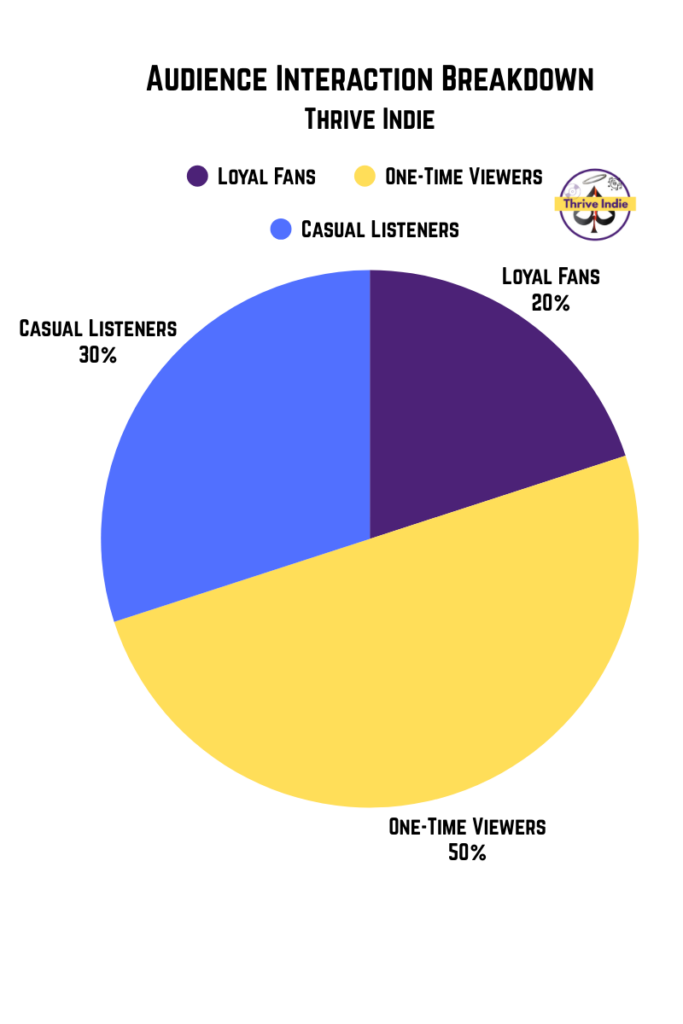
The majority of listeners are passive.
The goal is to move people from passive to casual to loyal. Yes, 20 percent of an artist’s total listeners are actually loyal fans. For those familiar with the ‘Pareto principle,’ these numbers check out. In sales, 80 percent of a broker’s sales come from 20 percent of their clients. The same goes for artists.
Community-building strategies directly increase that 20% segment.
Community begins with clarity.
If fans cannot answer:
They won’t attach emotionally.
Artists like Russ built strong communities by repeatedly communicating independence, ownership, and self-belief — across music and content. Repetition created identity clarity.
Community is two-way.
Instead of:
“New song out now.”
Shift to:
“What line hit you hardest?”
Research on audience engagement consistently shows that interactive content drives higher retention than announcement-only posts.
When fans comment, share opinions, and respond, they feel included.
Inclusion builds belonging.
Belonging builds community.
Algorithms change. Communities endure. TikTok and Instagram are great platforms for gaining attention, but artists who last create their own networks.
Smart independent artists:
Direct communication creates ownership.
Many independent artists credit Discord and email lists for stabilizing engagement even when social reach fluctuates.
Music releases are moments.
Process is ongoing.
Artists who document:
Invite fans into the journey.
Artists like Jon Bellion built early community loyalty by showcasing process and personality — not just finished tracks.
Process builds intimacy.
Intimacy builds loyalty.
Community forms when fans feel useful.
Examples:
When fans participate, they invest emotionally.
Investment increases retention.
Your follower count does not equal fans. Followers are passive. They respond to the algorithm, not the artist. Fans are emotionally invested. An artist’s follower count is what’s considered a vanity metric, while their fanbase represents a revenue metric.
Community is built between drops. Smart artists allow their fans to be a part of the process. This builds a deeper psychological and emotional connection, helping convert passive viewers into active participants.
Inconsistent messaging prevents recognition. On social media, clear signals beat clever content as we explain in this article. Social media rewards brands that are easy to understand. Not the loudest. Not the most inventive. The ones that send the same signals often enough that people don’t have to pause and figure out what they’re looking at.
Community forms when fans feel useful.
Examples:
When fans participate, they invest emotionally.
Investment increases retention.
Your follower count does not equal fans. Followers are passive. They respond to the algorithm, not the artist. Fans are emotionally invested. An artist’s follower count is what’s considered a vanity metric, while their fanbase represents a revenue metric.
Community is built between drops. Smart artists allow their fans to be a part of the process. This builds a deeper psychological and emotional connection, helping convert passive viewers into active participants.
Inconsistent messaging prevents recognition. On social media, clear signals beat clever content as we explain in this article. Social media rewards brands that are easy to understand. Not the loudest. Not the most inventive. The ones that send the same signals often enough that people don’t have to pause and figure out what they’re looking at.
Community forms when fans feel useful.
Examples:
When fans participate, they invest emotionally.
Investment increases retention.
Your follower count does not equal fans. Followers are passive. They respond to the algorithm, not the artist. Fans are emotionally invested. An artist’s follower count is what’s considered a vanity metric, while their fanbase represents a revenue metric.
Community is built between drops. Smart artists allow their fans to be a part of the process. This builds a deeper psychological and emotional connection, helping convert passive viewers into active participants.
Inconsistent messaging prevents recognition. On social media, clear signals beat clever content as we explain in this article. Social media rewards brands that are easy to understand. Not the loudest. Not the most inventive. The ones that send the same signals often enough that people don’t have to pause and figure out what they’re looking at.
Examples:
When fans participate, they invest emotionally.
Investment increases retention.
Your follower count does not equal fans. Followers are passive. They respond to the algorithm, not the artist. Fans are emotionally invested. An artist’s follower count is what’s considered a vanity metric, while their fanbase represents a revenue metric.
Community is built between drops. Smart artists allow their fans to be a part of the process. This builds a deeper psychological and emotional connection, helping convert passive viewers into active participants.
Inconsistent messaging prevents recognition. On social media, clear signals beat clever content as we explain in this article. Social media rewards brands that are easy to understand. Not the loudest. Not the most inventive. The ones that send the same signals often enough that people don’t have to pause and figure out what they’re looking at.
Examples:
When fans participate, they invest emotionally.
Investment increases retention.
Common Mistakes Independent Artists Make When Trying to Build Community
Your follower count does not equal fans. Followers are passive. They respond to the algorithm, not the artist. Fans are emotionally invested. An artist’s follower count is what’s considered a vanity metric, while their fanbase represents a revenue metric.
Community is built between drops. Smart artists allow their fans to be a part of the process. This builds a deeper psychological and emotional connection, helping convert passive viewers into active participants.
Inconsistent messaging prevents recognition. On social media, clear signals beat clever content as we explain in this article. Social media rewards brands that are easy to understand. Not the loudest. Not the most inventive. The ones that send the same signals often enough that people don’t have to pause and figure out what they’re looking at.
Search interest in:
continues to rise because artists are realizing that sustainable growth requires connection, not just attention.
When you optimize for:
You increase algorithmic trust across platforms.
Streams fluctuate.
Trends expire.
Algorithms shift.
Community compounds.
Independent artists who build community around their music:
If you want growth without a label, stop asking how to get more views.
Start asking how to build belonging. For the complete framework, revisit:
👉 How Independent Artists Get Fans Without a Label


2 thoughts on “How Independent Artists Build Community Around Their Music”