 11
11
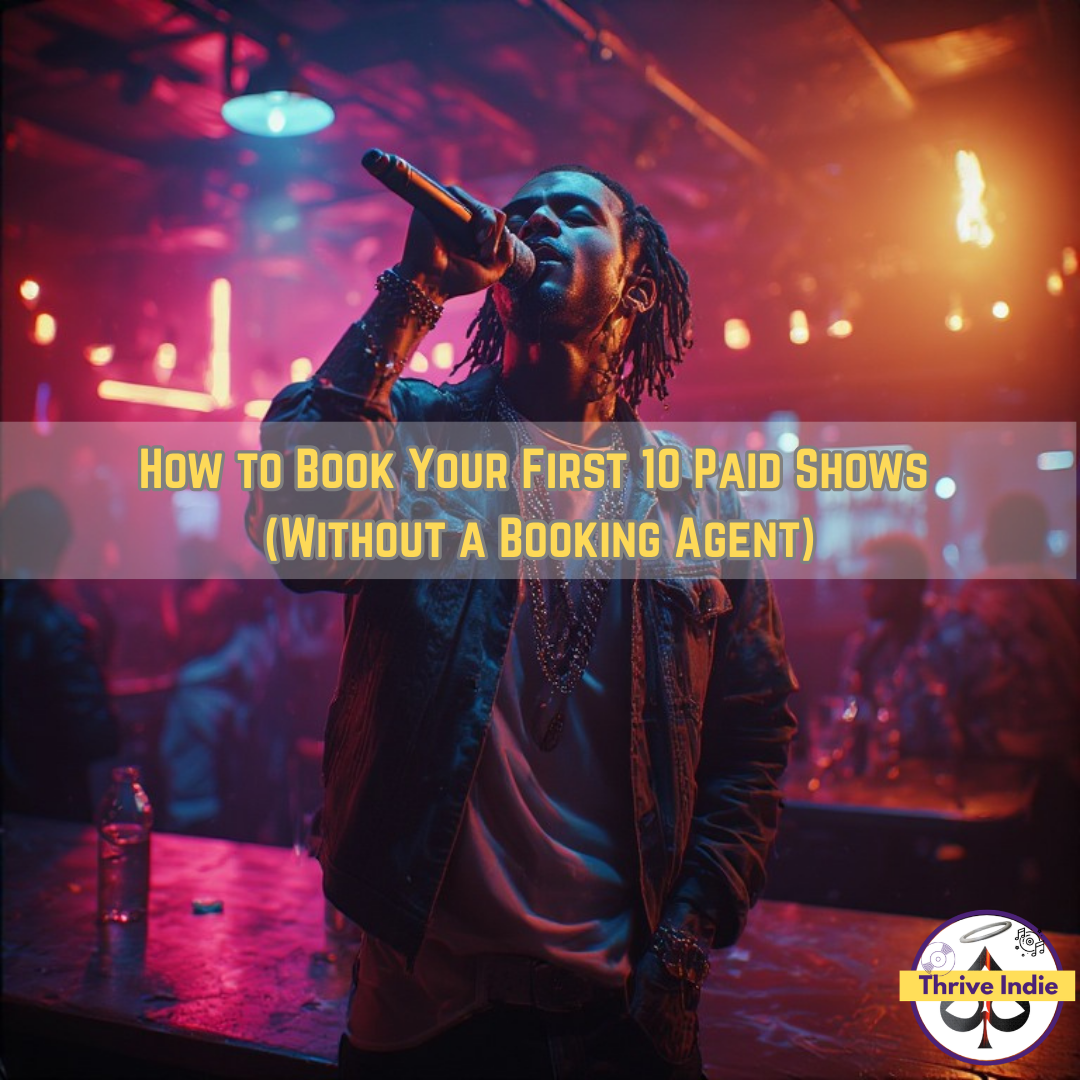

Live shows are not optional.
If you’re serious about sustainability, your first 10 paid shows are a financial and psychological breakthrough. They prove you can convert listeners into buyers. They establish your local footprint. And they teach you more about your audience than 100,000 passive streams ever will.
If you’ve read our pillar guide, “How Independent Artists Make Money,” you already understand that streaming is discovery — live performance is monetization. This article shows you exactly how to get there.
Here’s the math most artists ignore:
• 1,000 streams ≈ $3–$5
• 100 people at $15 per ticket = $1,500 gross
• Add merch sales? You double your revenue
Independent artists like Nipsey Hussle proved early that direct-to-fan revenue scales faster than streaming alone. Before major recognition, he monetized community support through local shows and physical sales.
Your first 10 shows won’t be glamorous. But they will create:
Before emailing venues, you need evidence.
Venues don’t book talent.
They book ticket sales.
Create a “local leverage list”:
Use Spotify for Artists city analytics. If 200 monthly listeners are in Greensboro, Atlanta, or Charlotte — that’s your pitch angle.
Independent artist Russ built regional leverage by identifying concentrated listener cities before expanding touring. He scaled market by market — not randomly.
SEO Tip: This step supports “how to book gigs as an independent artist” because venues prioritize demonstrated draw.
One of the biggest mistakes indie artists make:
Trying to headline too early.
Instead:
Open for local artists with momentum
• Offer to sell tickets directly
• Guarantee 15–25 attendees
When Chance the Rapper was emerging, he strategically aligned with local Chicago acts before national touring. That proximity accelerated visibility.
Your first paid shows may look like:
That’s fine.
Momentum > ego.
Most artists send weak DMs.
Here’s a professional outreach structure:
Subject: Local Artist With 300+ Greensboro Listeners
Body Framework:
Keep it under 200 words.
Venues want clarity.
Target small-to-mid-size rooms:
Avoid cold-emailing 1,000-capacity venues with no draw. That damages credibility.
The fastest way to 10 paid shows is stacking geography.
If you book one show in Charlotte:
This creates urgency.
Artists like Tobe Nwigwe built strong regional markets before national attention by maximizing concentrated runs rather than scattered one-offs.
Cluster strategy reduces travel cost and builds density.
Waiting on venues to sell tickets is passive.
Instead:
If you guarantee 25–40 tickets consistently, venues will rebook you.
This is how you transition from $100 opener to $500 headliner.
Every paid show creates:
Post clips with captions like:
“Greensboro showed up. Charlotte next.”
Venues research your social media before booking.
No performance content = no confidence.
Don’t rely on ticket splits alone.
Structure:
• 60 attendees
• 15 buy $30 merch = $450
• 40 join email list
That single show now feeds future income.
This aligns directly with our core strategy in How Independent Artists Make Money — stack revenue, don’t depend on one stream.
Early pricing models:
Once you consistently bring 75–100 attendees, you can negotiate flat guarantees.
Remember:
Consistency increases your booking power.
Your first 10 paid shows don’t all have to be traditional venues.
Consider:
Indie artists frequently leverage community events to build proof before traditional bookings.
Think ecosystem, not stage.
After every show, document:
You are building a booking resume.
By show #6 or #7, you should have:
This becomes your leverage pitch for bigger venues.
Let’s outline a realistic trajectory:
Show 1: Opener, $100 + 10 merch sales
Show 2: Ticket split, 25 attendees
Show 3: Opening slot in nearby city
Show 4: Co-headline event
Show 5: 50-person draw, $400 total income
Show 6–8: Weekend run, 3 cities
Show 9: 75-person draw, strong merch
Show 10: First profitable headline
At this stage, you’ve proven market viability.
Now you can scale.
Booking agents come after leverage — not before.
Streaming creates awareness.
Live shows create income, loyalty, and culture.
Your first 10 paid shows are not about ego.
They’re about:
And once you prove that, venues stop questioning you.
They start calling you.
If you’re waiting for permission, you’re delaying income.
Start local.
Be strategic.
Guarantee draw.
Stack revenue.
Your first 10 paid shows won’t just pay you —
They’ll shift how you see your career.
One thought on “How to Book Your First 10 Paid Shows (Without a Booking Agent)”
Comments are closed.