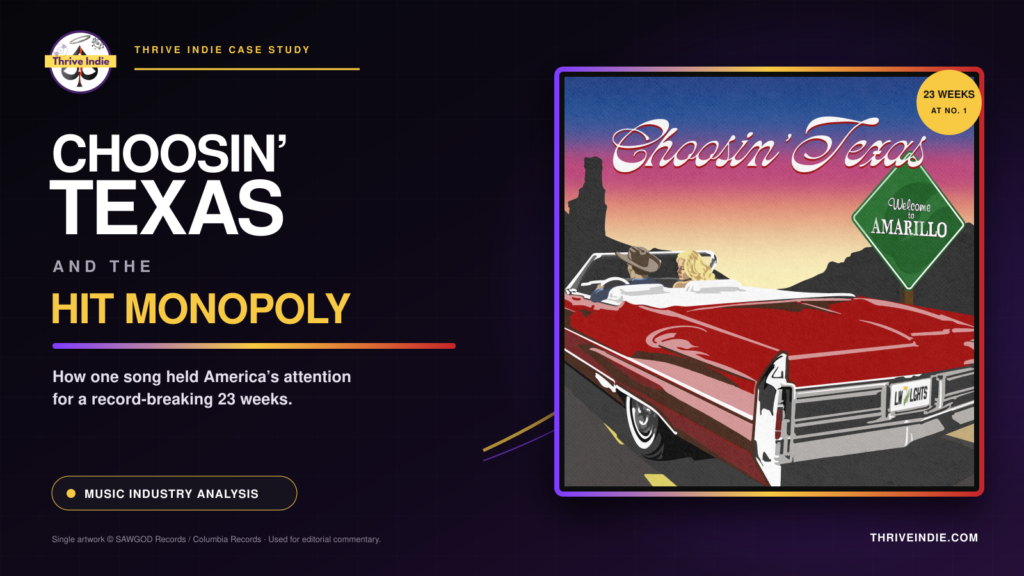
“Choosin’ Texas” Billboard Record and the Hit Monopoly
Across 23 weeks at No. 1—nearly half a year of chart time—the most popular song in America was the same.
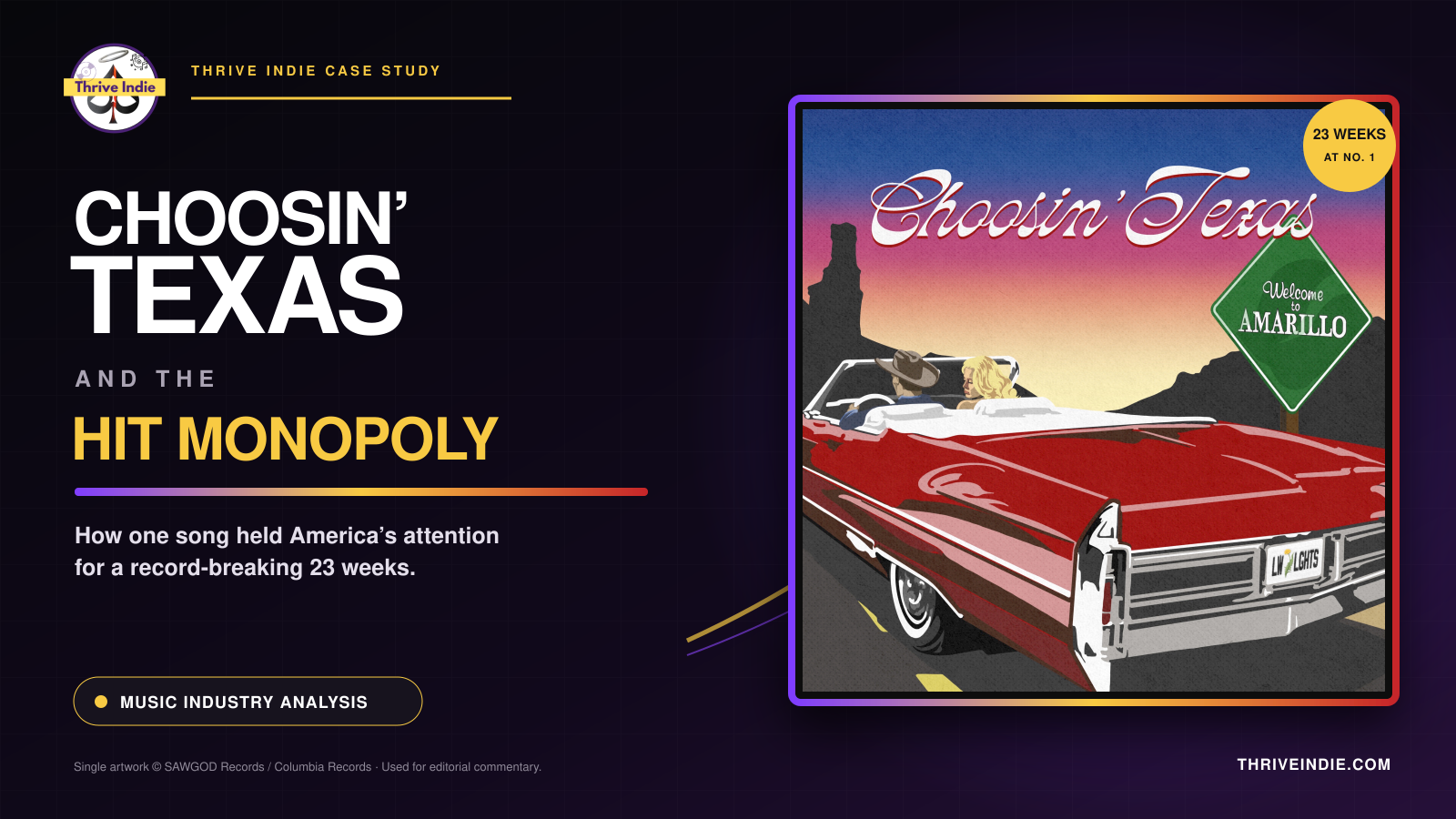
Ella Langley’s “Choosin’ Texas” officially became the longest-running No. 1 in Billboard Hot 100 history when it claimed its 23rd week at the top. The song surpassed the 22-week record previously held by Mariah Carey’s “All I Want for Christmas Is You” and moved ahead of historic hits from Lil Nas X, Shaboozey and other artists whose biggest records once appeared almost impossible to catch. The Associated Press called it the biggest hit of 2026, while Entertainment Weekly documented the record it broke.
To be clear, the “Choosin’ Texas” Billboard record does not automatically make it the biggest song ever under every possible measurement. Billboard maintains different rankings for different achievements. But no song has accumulated more weeks at No. 1 on the Hot 100, making this more than another successful country release.
It also raises a larger question Thrive Indie has explored before: When does attention become influence, and how does that process work in today’s music industry?
Listeners now have access to more music than any previous generation. Every day brings new releases, emerging artists, viral clips, and algorithmic recommendations competing for a place in their lives. Discovery appears limitless. Yet despite all those choices, one song remained at the center of American listening for 23 chart weeks.
How does that happen?
The simplest explanation is that “Choosin’ Texas” connected with people. Its heartbreak narrative, strong songwriting, and country foundation traveled far beyond its original audience. But emotional connection alone does not explain how a hit becomes this dominant. Once the song gained momentum, streaming, radio, social media, sales, and press coverage helped it grow even larger.
The Hot 100 combines U.S. streaming, radio airplay, and sales activity, so the song’s reign reflected strength across several forms of consumption rather than one isolated viral event. Axios’ account of the record describes a hit whose popularity expanded across mediums instead of depending on a single ecosystem.
Thrive Indie calls the environment surrounding this kind of dominance the Hit Monopoly: a music economy in which a disproportionate share of public attention circulates a small number of proven records.
It is not a literal monopoly over what audiences are allowed to hear. It is a concentration of what audiences are repeatedly encouraged to notice.
The mechanism driving that concentration is what we call the Hit Concentration Effect, or HCE—the process through which early success attracts additional exposure, allowing the largest hits to become even larger and remain visible longer.
“Choosin’ Texas” did not become historic because of one algorithm, platform, or marketing decision. It became historic because enough parts of the music industry began strengthening the same winner at the same time.
Before examining how that cycle worked, we first need to understand the true size of what Ella Langley accomplished.
How Big Was the “Choosin’ Texas” Billboard Record?
Cover art for Ella Langleys second album Dandelion
“Choosin’ Texas” was released in October 2025 as the lead single from Ella Langley’s album Dandelion. It entered the Hot 100 shortly afterward, reached the top 10 in January, and claimed its first week at No. 1 in February. What began as a successful country release developed into the biggest hit of 2026 and eventually the longest-running No. 1 in Hot 100 history.
The 23-week total placed “Choosin’ Texas” ahead of records that once appeared nearly untouchable. Mariah Carey’s “All I Want for Christmas Is You” accumulated 22 weeks at No. 1 through repeated holiday returns. Lil Nas X’s “Old Town Road” and Shaboozey’s “A Bar Song (Tipsy)” each held the position for 19 weeks. “Choosin’ Texas” surpassed all three.
Its dominance was not limited to one measurement. The song also tied BTS’s “Dynamite” and “Butter” for the most weeks at No. 1 on Billboard’s Digital Song Sales chart, while its reach continued expanding through radio and streaming.
By mid-August, “Choosin’ Texas” had generated approximately 911 million on-demand streams in the United States and 1.26 billion globally, according to Luminate figures reported by the Associated Press. Its growth moved well beyond country music. After gaining traction on Spotify’s Hot Country playlist, the song entered broader playlists such as Today’s Top Hits and mood-based collections built around driving, cooking, and relaxing.
That expansion matters. A country song can become highly successful by dominating country radio and appealing deeply to the genre’s core audience. “Choosin’ Texas” did both, but its historic run required it to reach people who may not normally consider themselves country listeners. The song did not abandon its identity to cross over. Its country foundation became the starting point for a much larger audience.
The growth also extended beyond the single.
Langley had fewer than one million monthly Spotify listeners at the beginning of 2023. By September 2026, that figure had grown beyond 32 million. Dandeliondebuted at No. 1 on the Billboard 200, while “Be Her” and “I Can’t Love You Anymore” joined “Choosin’ Texas” among three album tracks to reach the Hot 100’s top 10. The Atlantic’s profile of Langley treated that broader catalog performance as evidence that the story was becoming larger than one record.
The achievement can therefore be understood on three levels:
Discovery: “Choosin’ Texas” escaped its original audience and reached listeners across genres, platforms, and listening situations.
Dominance: It became the most popular song in America through the combined strength of streams, radio airplay and sales.
Retention: It continued holding or reclaiming the top position until it accumulated more weeks at No. 1 than any song before it.
That final accomplishment turns “Choosin’ Texas” into an important music-industry case study. Reaching the top proves that a song captured attention. Accumulating 23 weeks there raises a different question: Why, in an era of nearly unlimited choice, is so much attention becoming concentrated around so few records?
The Music Industry Attention Paradox
This is the central paradox of today’s music industry: listeners have more choices, but a small group of songs can still command a disproportionate share of their attention.
Spotify alone provides access to more than 100 million tracks. Independent artists can release music without a label, reach international audiences, and promote themselves directly through social media. The barriers to distribution have fallen, creating what appears to be the most open music market in history.
But the ability to release music is not the same as the ability to be discovered.
As more songs compete for the same limited number of listeners, playlist positions, social-media views, and hours in the day, greater access can create greater obscurity. Discovery is more available, but it is surrounded by more noise. That helps explain why independent artists can possess more promotional tools than any previous generation and still struggle to develop an audience.
The streaming era was expected to create a “long tail” in which listeners could move beyond mainstream hits and support countless niche artists. That has happened to a degree. Smaller artists can find listeners without becoming household names, and fans can build personalized musical worlds around specific scenes, genres, and moods.
At the highest level, however, a different pattern is visible.
A peer-reviewed study examining 65 years of Billboard Hot 100 history found that most songs now spend less time on the chart than songs did in previous eras. At the same time, songs that reach No. 1 have tripled their chart lifetimes since the 1960s, the highest-ranked songs maintain their positions longer, and fewer new artists reach the chart.
In other words, the middle is moving faster while the top is becoming harder to dislodge.
“Choosin’ Texas” is an extreme example. Its 23 weeks at No. 1 did not occur in an era of limited competition. They happened while listeners had access to nearly unlimited alternatives. The record became more dominant while the overall market became more crowded.
That distinction matters for independent artists.
The modern music business presents itself as an open competition in which every release has an opportunity to win. Technically, almost anyone can enter. But entry does not guarantee equal visibility, access, or support. As Thrive Indie explored in The Music Industry Isn’t Competitive Anymore—It’s Controlled, distribution has been democratized more fully than attention.
This does not mean audiences are forced to consume music they dislike. “Choosin’ Texas” still needed to connect with listeners. But once that demand became measurable, the song gained advantages unavailable to an unproven release at the same scale.
Success made the record safer to recommend. Streams produced more data. Chart milestones made the song more newsworthy. Familiarity reduced uncertainty for radio programmers, playlist editors, and casual listeners. The larger the hit became, the easier it was for another part of the industry to justify supporting it.
That is the environment described by the Hit Monopoly: millions of songs remain available, but a relatively small group repeatedly receives the strongest opportunities to be noticed.
Something still has to transform early momentum into repeated exposure and repeated exposure into lasting dominance.
That process is the Hit Concentration Effect.
3. The Hit Concentration Effect: How Music Success Compounds
The Hit Concentration Effect
If the Hit Monopoly describes the environment surrounding modern hits, the Hit Concentration Effect explains how that environment reproduces itself.
The Hit Concentration Effect is the process through which early success attracts additional exposure, allowing successful songs to accumulate attention faster and remain visible longer.
Put simply:
Success becomes an input for more success.
The idea that popularity can compound is not new. In a landmark experiment examining social influence in music, researchers created an artificial market in which 14,341 participants listened to and downloaded songs by unknown artists. Some participants made their choices independently. Others could see what previous listeners had downloaded.
When people could see the earlier choices, success became more unequal and harder to predict in advance. Small early differences were amplified by social influence, allowing the same song to perform differently across separate groups. Quality still mattered—the strongest songs rarely performed terribly, and the weakest rarely became the most successful—but quality did not determine the outcome by itself.
HCE applies that principle to a music industry in which popularity is visible almost everywhere. Listeners encounter stream counts, chart positions, trending sounds, playlist placements, social-media views, and headlines announcing new milestones. These signals do more than document success. They can help extend it.
Stage 1: Initial Demand
The cycle begins when a song creates a genuine response. Strong songwriting, emotional connection, an existing audience, effective promotion, cultural timing, or social participation may all contribute.
HCE cannot fully explain why one song connects before another. Music remains emotional and difficult to predict. The framework begins after a record produces enough activity to become visible to the systems surrounding it.
Stage 2: Data Validation
Momentum produces information. Streaming services can observe whether people return to a song, save it, add it to playlists, or search for the artist. Social platforms can measure watch time, shares, comments, and reuse. Labels, marketers, and radio programmers can observe whether interest is expanding across cities, demographics, and platforms.
This reflects the shift Thrive Indie anticipated in Will Big Data Trump Big Ears?. Human judgment still matters, but streaming growth, social activity, and audience behavior increasingly help the industry identify momentum.
At this stage, the question begins changing from “Is this a good song?” to “What is the audience already telling us about this song?”
Stage 3: Increased Exposure
When the data indicates demand, the song becomes easier to support. It may receive broader recommendations, larger playlist placements, additional radio rotation, greater marketing investment, or stronger press interest.
Spotify says its recommendation systems select and order content using information about users, content, and context. The precise weight of individual signals is not public, but proven audience response gives platforms evidence that a record is connecting.
For independent artists, Thrive Indie’s guide to how the Spotify algorithm works explains how listener behavior can turn early activity into broader distribution.
Stage 4: Public Confirmation
As exposure increases, the song accumulates visible proof of success: major playlists, higher stream counts, heavier radio rotation, chart positions, sold-out shows, and media coverage.
At that point, popularity becomes a message of its own. A No. 1 ranking tells casual listeners that a song matters in the present moment. A milestone gives media outlets a reason to cover it. A visible trend invites participation.
Stage 5: Renewed Consumption
Public confirmation sends people back to the music. New listeners investigate it, existing fans celebrate it, and critics revisit it to debate whether the success is deserved.
That activity creates more streams, searches, sales, videos, and conversation. The cycle begins again:
Demand creates data. Data attracts exposure. Exposure creates public confirmation. Public confirmation renews demand.
The effect does not require central coordination. Each part of the industry can independently reach the same conclusion: the song is already working, audiences recognize it, and supporting it carries less uncertainty than supporting something unproven.
“Choosin’ Texas” needed real demand to enter this cycle. Once it did, every additional platform, milestone, and listener created another opportunity for the song to reach the next one.
To understand why this record activated HCE so powerfully, we have to examine what made it capable of entering the cycle in the first place.
4. Why Is “Choosin’ Texas” So Popular?
The Hit Concentration Effect can amplify demand, but it cannot manufacture the original connection.
Before platforms, radio programmers and media outlets could strengthen “Choosin’ Texas,” the song had to give people a reason to respond. Its historic run began with emotional storytelling, a clear identity, experienced collaborators, an artist whose career was already growing, and several ways for audiences to participate.
A Specific Story Built Around a Universal Emotion
At its core, “Choosin’ Texas” is a heartbreak song about recognizing that the person you love may be choosing another place, another person, and another life.
Listeners do not need to live in Texas or Tennessee to understand the feeling of watching a relationship slip away. But the song does not communicate that emotion through generic language alone. Regional references and specific details give the heartbreak a physical setting. Texas and Tennessee become competing loyalties and emotional destinations.
That balance between specificity and universality is one of the record’s strengths. The details make the story memorable; the emotion allows listeners to place themselves inside it.
The Washington Post’s examination of the song credited its rise to a combination of storytelling, production, cross-generational familiarity, and a sound capable of moving beyond country’s traditional audience.
A Country Identity With Crossover Range
“Choosin’ Texas” did not reach the mainstream by hiding its country identity.
The storytelling, regional references, and Langley’s vocal performance place the song clearly within the genre. At the same time, its pop, rock, soul, and rhythmic qualities allow it to function in broader listening environments.
Traditional country listeners could recognize its language and musical references. Younger streaming listeners could encounter it through mainstream playlists and short-form video. Casual listeners could connect with the heartbreak without understanding every country reference.
The song’s movement from Hot Country into mainstream and activity-based Spotify playlists widened its audience without weakening the identity that made it recognizable.
The Hit Landed on a Prepared Artist
“Choosin’ Texas” introduced Langley to millions of new listeners, but it was not the beginning of her career.
She had spent years developing through songwriting, touring, live performance, nd social media. Earlier records—including “If You Have To” and “You Look Like You Love Me”—gave her experience converting online attention into broader momentum.
By the time “Choosin’ Texas” arrived, listeners were not encountering an artist with no identity or catalog. Langley already had a recognizable Southern vocal style, an established country audience, touring experience, previous viral moments, nd a growing body of work.
The record did not create every part of her career. It concentrated years of development into one breakthrough moment.
Experienced Collaborators Strengthened the Record
Langley wrote “Choosin’ Texas” with Miranda Lambert, Luke Dick and Joybeth Taylor, then co-produced it with Lambert and Ben West.
That team combined Langley’s emerging identity with significant songwriting and production experience. Lambert contributed more than celebrity recognition: she helped shape the record while allowing Langley to remain at its center.
The result was not a song assembled to satisfy every possible listener. It was a focused record created by people who understood the artist, the genre, and the emotional story.
The Audience Could Participate
Listeners did not only stream “Choosin’ Texas.” They found ways to use it.
Each piece of content provided another entrance into the same record. One person might encounter it through a dance, another through a breakup video, and someone else through a concert clip or chart debate.
This is the evolution Thrive Indie documented on TikTok: Fad or Factor?. Short-form platforms do not only distribute music; they allow audiences to reinterpret it and introduce it to people the original campaign may never have reached.
More Than One Discovery Engine
Many viral songs depend on a single platform. That can create an enormous spike, but the momentum may disappear when the trend ends.
“Choosin’ Texas” was supported by several discovery engines at once: TikTok participation, streaming playlists, country and pop radio, digital sales, live performances, press coverage a, nd chart milestones.
Different channels introduced the song to different audiences, and those audiences eventually overlapped. Describing it as merely a TikTok hit, radio hit o, or algorithmic hit misses the larger point. It became historic because no single platform carried the entire burden.
Those qualities explain why “Choosin’ Texas” entered the HCE cycle. What happened next explains how the cycle kept renewing itself.
5. From Attention Spike to Attention Cycle
“Choosin’ Texas” did not accumulate 23 weeks at No. 1 because its original release campaign simply lasted longer than every competing campaign. Its momentum repeatedly received new fuel.
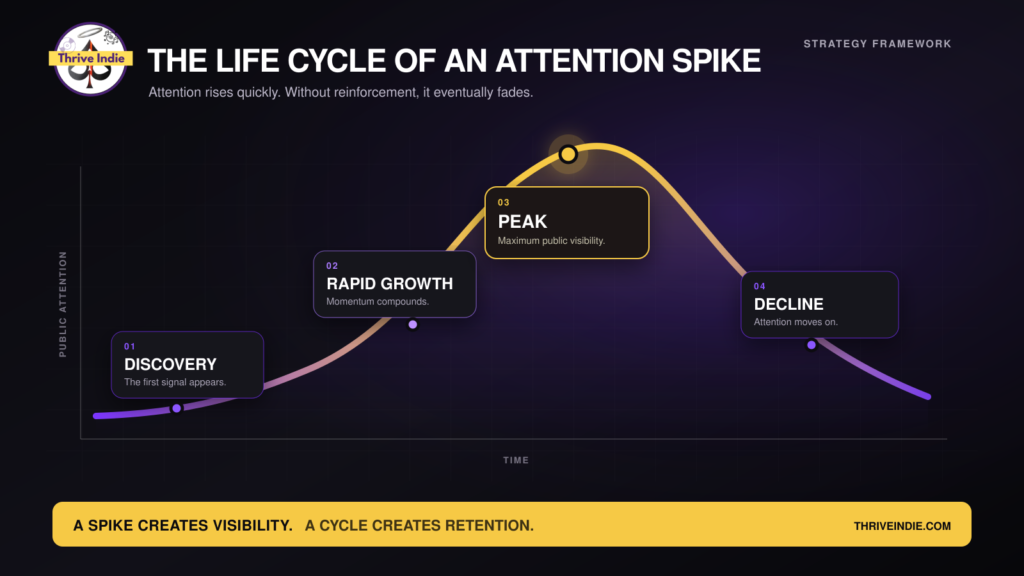
An attention spike follows a familiar pattern:
The Attention Spike Cycle
A viral performance, celebrity mention, trend o, or playlist placement may introduce a song to millions of people. If nothing reinforces the moment, the audience moves on.
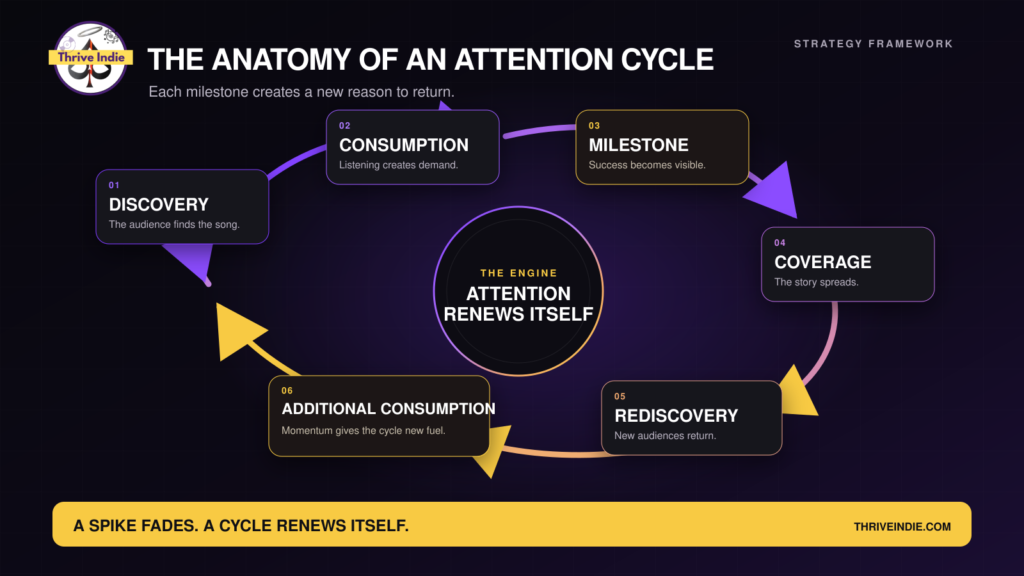
An attention cycle works differently:
Attention Cycle
The original moment does not need to last forever. New moments keep forming around it.
The Initial Rise Became a Public Competition
After its October 2025 release, “Choosin’ Texas” entered the Hot 100, reached the top 10 in January, nd climbed toward No. 1 in February. As it approached the top, its chart position became part of the story.
When the record reached No. 2, Langley encouraged fans to help push it to No. 1, presenting the achievement as a potential victory for women in country music. Chart watching became participatory. Fans were not only listening to a rising song; they were helping it pursue a milestone.
Reaching No. 1 delivered the payoff—and created the next story.
No. 1 Expanded the Meaning of the Record
“Choosin’ Texas” became the first song by a woman to lead the Hot 100, Hot Country Songs and Country Airplay charts simultaneously.
That allowed the record to be discussed as a pop success, a country achievement, a milestone for women in the genre, Langley’s first Hot 100 leader, and evidence of country music’s crossover power.
Each angle introduced the song to a different audience. The milestone expanded its meaning beyond the recording itself.
The song did not remain No. 1 without interruption throughout its entire run. Earlier losses and returns created new headlines and changed the question from “Can Ella Langley reach No. 1?” to “How long can ‘Choosin’ Texas’ keep returning and holding on?”
The Video and Album Renewed the Story
By April, the song was already several months old. Instead of treating the campaign as complete, Langley expanded its world through a cinematic music video featuring Miranda Lambert, Luke Grimes, Ava Phillippe, and other guests. People’s coverage of the video generated another wave of attention around a story listeners already knew.
This demonstrates the difference between repetition and reinforcement.
Repetition asks audiences to consume the same asset again. Reinforcement provides a new way to experience the same central idea.
Later that month, Dandelion debuted at No. 1 on the Billboard 200. Coverage of the album referenced “Choosin’ Texas,” while the song directed listeners toward the album. The success of “Be Her” and “I Can’t Love You Anymore” strengthened the cycle further by giving new listeners somewhere else to go.
Every Milestone Created the Next Record Chase
As the No. 1 weeks accumulated, the milestones became progressively larger: a country crossover, Langley’s first Hot 100 leader, a historic run for a female country artist, a challenge to “Old Town Road” and “A Bar Song (Tipsy),” a tie with Mariah Carey, and finally a new record.
The closer the song moved toward history, the more newsworthy every additional week became. Listeners who had stopped following it could return to see whether it would pass the next landmark.
At that level, success becomes part of the product. Chart updates become social posts. Milestones become graphics. Record chases become news stories. Fans celebrate each achievement while critics revisit the music to debate whether it deserves the attention.
The song still needed streams, radio airplay, and sales. But each milestone gave existing listeners a reason to return and potential listeners a reason to investigate.
“Choosin’ Texas” did not experience one uninterrupted six-month viral moment. It experienced a sequence of connected moments that kept renewing attention.
The next question is whether Ella Langley retained the audience.
6. Did the Hit Build the Artist—or Only the Song?
Twenty-three weeks at No. 1 proves that Ella Langley retained attention around a record. The next several years will reveal how much of that attention became career equity.
That distinction matters because a hit song and a successful artist career are not the same thing. A record can accumulate billions of streams, dominate radio, and remain culturally unavoidable without transferring all of that demand to the person who created it.
The question is no longer whether “Choosin’ Texas” became enormous.
The question is: What did it build beyond itself?
Three Levels of Retention
The song’s success can be evaluated across three levels:
Song retention: Did listeners continue returning to the record?
Audience retention: Did those listeners explore Langley’s other music and begin following her as an artist?
Career retention: Did the attention create lasting demand for albums, tours, collaborations, and future releases?
The first level is undeniable. The second is already visible in Langley’s expanded Spotify audience, three simultaneous top-10 album tracks and the No. 1 debut of Dandelion.
Touring provides another sign of conversion. After selling out the initial run of The Dandelion Tour, Langley added 21 dates to a headline arena run. Pollstar’s report on the expansion described it as an extension of an already sold-out tour.
That matters because attending a concert requires more commitment than allowing a song to play. It requires money, time, and a belief that the artist can provide an experience larger than one recording.
The album, catalog, and touring evidence suggest that some of the “Choosin’ Texas” audience has moved deeper into Langley’s career. It does not yet prove that the conversion will last.
Career Retention Is the Hardest Test
Career retention cannot be measured fully during the peak of the original hit. Playlist placement, interviews, collaborations, award-show appearances, and ticket demand may all still be benefiting from the same momentum.
The clearest evidence will come after “Choosin’ Texas” leaves the center of public attention.
Will listeners continue playing Dandelion? Can the next album attract interest without requiring another historic single? Will fans keep buying tickets when “Choosin’ Texas” becomes one part of the catalog rather than the dominant song in America?
These questions apply to every artist who experiences sudden visibility. As Thrive Indie explains in Are You Building a Career—or Feeding the Algorithm?, platform success and career development are different processes.
A hit creates an opening. The artist and team must build the infrastructure that keeps people inside.
That includes a recognizable identity, a strong catalog, compelling performances, direct fan relationships, and systems that convert attention into repeat participation. Thrive Indie’s two-layer artist infrastructure model makes the same distinction: the front end creates discovery, while the back end captures and converts the resulting value.
The Burden of Historic Success
Breaking the all-time Hot 100 record creates an unusual problem: almost anything Langley releases next could appear smaller by comparison.
A future single could become a major hit, fill arenas and strengthen her career while still failing to approach 23 weeks at No. 1. Treating another record-breaking run as the only acceptable outcome would turn normal career growth into apparent decline.
Langley does not need to reproduce the exact performance of “Choosin’ Texas.” She needs the record to raise her baseline: more catalog listening, greater demand for future releases, stronger ticket sales, increased opportunities, and an identity audiences recognize beyond one song.
If those advantages remain after the original attention cycle fades, “Choosin’ Texas” will have changed the trajectory of her career.
A Historic Record Is Not the Same as a Lasting Legacy
Twenty-three weeks at No. 1 proves extraordinary commercial dominance. It does not determine what “Choosin’ Texas” will mean five, ten, or twenty years from now.
Chart performance measures consumption during a particular period. Cultural impact asks broader questions: Did the song generate conversation? Did it influence other creators? Did it change behavior? Was it meaningful after its commercial peak?
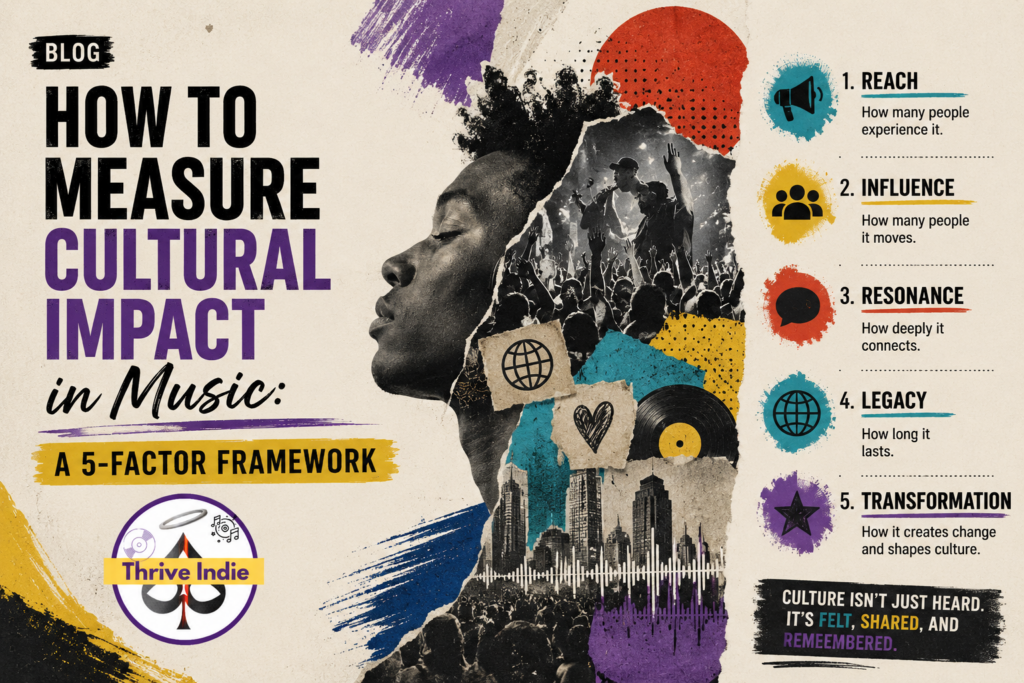
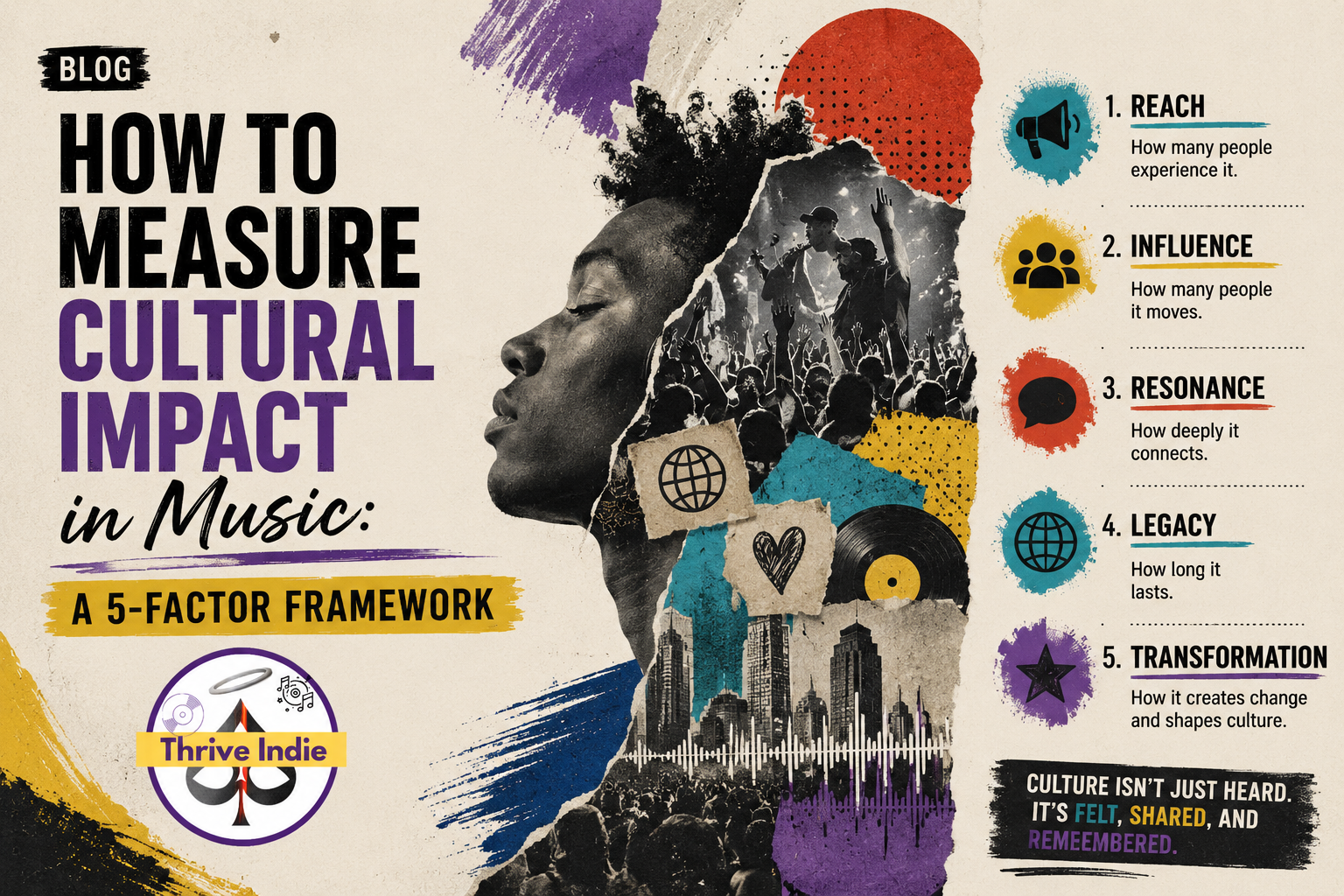
Under Thrive Indie’s five-factor cultural impact framework, the song has already demonstrated overwhelming attention and sustained conversation. There is also evidence that its reach is producing influence outside country music.
That crossover became visible when Drake created a “Choosin’ Texas” remix featuring Houston rapper Don Toliver and introduced it through his Fear of Missing Out short film. The Houston Chronicle’s response to the remix shows how quickly it carried the song into another cultural conversation.
When prominent hip-hop artists reinterpret a country record, they are doing more than acknowledging its chart position. They are treating the song as material worth rebuilding for another audience.
The remix is therefore strong evidence of influence and a preliminary sign of behavioral response. Drake and Don Toliver did not merely mention the record; they acted on its popularity by reworking it. That is meaningful, but it is not yet proof of broad or lasting behavior change.
The final factor—longevity—cannot be measured yet. Time must determine whether “Choosin’ Texas” becomes a permanent reference point, continues influencing artists, and remains familiar after the systems currently reinforcing it move on.
The record is already established.
The legacy is still being built.
Billboard can measure the length of the song’s reign. Only time can measure the size of its legacy.
7. Who Benefits From the Hit Monopoly?
The Hit Monopoly
The Hit Monopoly does not require a secret agreement between labels, streaming services, radio programmers, and media companies.
It can emerge naturally because nearly every participant in the music economy benefits from supporting records that have already demonstrated demand. Each decision can make sense on its own. HCE appears when those decisions repeatedly favor the same proven winners.
Streaming Platforms and Radio Benefit From Predictability
Streaming services must help listeners navigate catalogs containing more music than any person could explore. Recommendation systems solve part of that problem by using listening history, engagement, and context to decide what should appear next.
These systems can introduce unfamiliar artists, but proven songs carry less uncertainty. Once “Choosin’ Texas” demonstrated that it worked across country, mainstream, and activity-based playlists, every additional context created another opportunity for it to be heard.
Radio operates under a similar incentive. Stations have limited programming space, and every selection carries the possibility that a listener will stay or leave. A familiar hit reduces that uncertainty. Airplay creates familiarity; familiarity reduces risk, and reduced risk can produce more airplay.
Neither platform recommendations nor radio rotation created the song’s demand alone. They amplified demand that was already visible.
Labels and Rights Holders Benefit From Concentrated Demand
A record producing hundreds of millions of streams, significant airplay, and sustained sales generates revenue across several parts of the music business. The people and companies financially connected to it have an obvious reason to keep investing.
That investment may include additional marketing, radio promotion, playlist campaigns, remixes, videos, live performances, award submissions, and international expansion.
Supporting an unproven record requires accepting uncertainty. Supporting an established hit allows a company to invest behind measurable demand. Data does not merely describe the market; it helps direct the next round of resources.
Media and Social Platforms Receive Renewable Content
A song becoming popular is a story. Reaching No. 1 is another. Breaking a genre record, approaching a record, and finally surpassing it each create separate editorial moments.
“Choosin’ Texas” could be covered as the rise of a new country star, a crossover hit, a milestone for women, evidence of country music’s commercial strength, and a challenge to records associated with Mariah Carey, Lil Nas X, and Shaboozey.
Social platforms benefit for a related reason. Familiar songs help creators communicate quickly. A recognizable record can support dance videos, comedy, relationship stories, reactions, covers,s and commentary without requiring the creator to establish the context from the beginning.
The artist receives exposure. The creator receives engagement. The platform receives watch time. The audience receives content it can understand immediately.
Audiences Benefit—With a Tradeoff
Listeners are not passive victims of the Hit Monopoly. Popular songs can become shared experiences: something to sing together, debate online, play at events,s and associate with a specific period.
Familiarity also reduces the work required to choose music. When listeners are driving, exercising, or spending time with friends, a proven song provides an easy answer.
The tradeoff is that convenience can narrow discovery. Because prominent placements, programming slots, and headlines are limited, repeated support for established hits leaves fewer high-visibility opportunities for less-proven records.
The result is not an absence of choice. It is an unequal distribution of visibility.
The Winning Artist Benefits—Until Attention Becomes Dependency
Langley gained streaming growth, radio exposure, media recognition, touring demand, and access to audiences far outside her original base. “Choosin’ Texas” raised the ceiling of her career.
But when one song becomes much larger than the remaining catalog, interviews, performances, marketing, and future releases can all become trapped in its shadow. The artist benefits from concentrated attention while facing pressure to escape the identity that attention created.
The goal is not simply to remain attached to a winning record. It is to transfer the record’s attention into a durable relationship with the artist.
A System of Aligned Incentives
After “Choosin’ Texas” demonstrated real demand, nearly every participant had a reason to reinforce it:
Streaming platforms received reliable engagement.
Radio received a recognizable record.
Labels and rights holders received growing revenue.
Media received a continuing story.
Social platforms received reusable content.
Audiences received a shared cultural reference.
Langley received greater reach and career opportunity.
Together, those individually rational decisions concentrated an extraordinary amount of attention around one song.
The Hit Monopoly is not necessarily a conspiracy. It is an equilibrium—one in which nearly everyone benefits from supporting what is already winning, even when that support makes it harder for the rest of the market to be noticed.
What the “Choosin’ Texas” Billboard Record Means for Independent Artists
The “Choosin’ Texas” Billboard record was created at a scale most independent artists cannot reproduce. Langley had major-label support, national radio, prominent playlists, extensive media coverage, and enough existing demand to activate several parts of the industry simultaneously.
But independent artists do not need access to the entire machine to learn from the mechanism underneath it.
The practical lesson is that success becomes more valuable when each sign of demand is used to create the next opportunity.
1. Identify Winners Early
A winner is not necessarily a viral song. It is any song, video, story o, or campaign that meaningfully outperforms the artist’s normal baseline.
That might be a video receiving three times the usual views, a song earning an unusual number of saves, an older track gaining new listeners, or one city producing unexpected demand.
Spotify for Artists provides audience, music and playlist analytics that can help artists distinguish casual exposure from intentional listening. Social platforms offer additional clues through retention, shares, profile visits, and recurring comments.
The goal is not to let dashboards control every creative decision. It is to recognize when the audience is giving an unusually strong response.
2. Reinforce Proven Attention
Once a winner has been identified, give it more opportunities to win.
That does not mean posting the identical clip every day. It means expanding the idea through live versions, alternate arrangements, lyric explanations, behind-the-scenes stories, collaborations, fan reactions, and related follow-up content.
“Choosin’ Texas” stayed visible because its momentum was renewed through playlists, radio, milestones, coverage, a cinematic video, a successful album, and the Drake–Don Toliver remix.
The mistake is not releasing something new. It is moving on before the current winner has been fully developed.
3. Build Several Discovery Routes
Independent artists should create a smaller version of the multi-channel system that supported “Choosin’ Texas.” Streaming, short-form video, YouTube, playlists, local media, podcasts, live performances, collaborations, email, nd direct fan recommendations can all introduce the same release.
These routes should reinforce one another. A performance clip leads to the full song. The song leads to an interview. The interview leads to an email signup. The email promotes a show. The show produces more content and direct relationships.
Thrive Indie’s streaming growth strategy organizes this system around discovery, conversion, retention, expansion, and ownership.
An artist does not need to be everywhere. The artist needs several connected routes through which momentum can travel.
4. Give the Audience a Next Destination
Attention loses much of its value when the audience has nowhere to go.
If someone discovers an artist through one song, the desired next action might be another record, a Spotify follow, an email list, a show, merchandise, a membership o, or a larger story about the artist.
As Thrive Indie explains in How to Convert Listeners Into Fans, a stream is not the same as a relationship. The strongest destination is usually one the artist can reach again without depending entirely on an algorithm.
This is why infrastructure matters before the attention spike arrives. An audience cannot enter a system that has not been built.
5. Measure Conversion, Not Only Reach
Views and streams describe the size of the opening. Conversion metrics reveal how many people walked through it.
Artists should monitor whether attention produces more repeat listeners, saves, followers, catalog streams, email subscribers, website visits, ticket buyers, and merchandise customers.
Spotify’s audience-segmentation guide distinguishes programmed listeners from people who intentionally return to an artist through active sources. That difference changes how success should be interpreted.
One million passive streams may create visibility without establishing a reliable audience. A smaller number of people who return, join a list, nd buy tickets may create more career value.
6. Build the Independent Version of HCE
Independent artists cannot force the entire music industry to reinforce a record. They can build a smaller system in which each success improves the probability of the next.
Strong content creates discovery. Discovery produces streams and profile visits. Positive response encourages more distribution. New listeners enter the catalog and owned channels. Direct relationships create repeat engagement and revenue. Those resources strengthen the next release.
The goal is not to monopolize public attention. It is to prevent momentum from resetting to zero after every campaign.
A video should improve the next video’s chances. A song should increase catalog interest. A show should create content, contacts, and demand for the next performance. Each win should leave behind an asset: audience data, reusable content, stronger relationships, revenue, clearer branding o, or a better understanding of what resonates.
Independent artists do not need to recreate Ella Langley’s scale.
They need to recreate the compounding.
Conclusion: A Hit Is No Longer Just a Song
Choosin’ Texas and the Hit Monopoly
Ella Langley’s “Choosin’ Texas” became the longest-running No. 1 in Hot 100 history because people genuinely connected with the record. Its songwriting, emotional clarity, and crossover range created the original demand. Nothing about the Hit Monopoly or HCE should erase that accomplishment.
What made the record historic was what happened after that connection began.
Streaming expanded its reach. Radio increased its familiarity. Social media gave audiences new ways to participate. Coverage turned milestones into fresh stories. The album gave listeners somewhere else to go. Drake and Don Toliver carried the record into another genre and another conversation.
Each part of the music industry strengthened the others.
The Hit Monopoly describes the environment created when public attention repeatedly circulates proven records. The Hit Concentration Effect explains the mechanism underneath it: early success attracts exposure, exposure generates stronger evidence of demand, and that evidence makes additional support easier to justify.
The “Choosin’ Texas” Billboard record does not prove that listeners lack choice. It reveals the difference between available music and visible music.
That concentration creates a difficult environment for independent artists, but it also reveals a usable principle:
Attention should never be treated as the final result. It is raw material.
A moment of discovery should lead to another song. A successful song should introduce the catalog. The catalog should lead to a direct relationship. That relationship should create repeat participation, revenue, and stronger demand for what comes next.
This is how artists move from visibility to influence and from influence to career equity.
A modern hit is no longer just a recording people enjoy. It is the center of a network: content, data, platforms, media, audiences, business opportunities, a nd cultural meaning moving around the same piece of music.
“Choosin’ Texas” shows what happens when that entire network begins reinforcing one winner at the same time.
The record-breaking run will eventually end. The system it reveals will remain.
Understanding that system reflects the larger purpose of The Intellectual History of Thrive Indie: to examine not only what happens in the music industry, but why it happens and what independent artists can learn from it.
 1
1